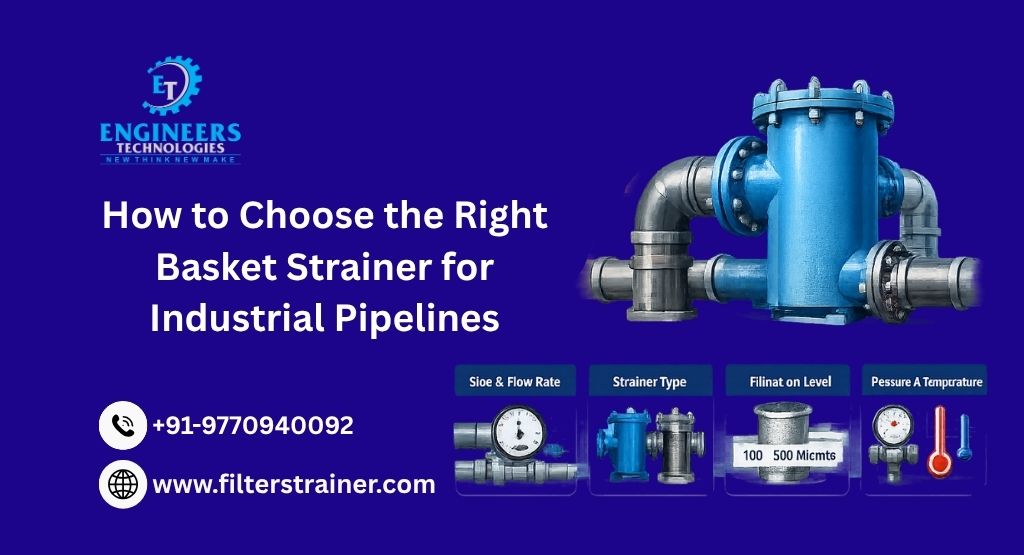
Industrial pipelines carry liquids, chemicals, oils, and process fluids that often contain unwanted debris. If these particles enter pumps, valves, or meters, they can cause serious damage and costly downtime.
This is where basket strainers become essential.
But choosing the wrong strainer can reduce efficiency, create pressure drops, or even damage the pipeline system.
In this basket strainer selection guide, experts at Engineers Technologies explain how to select the right basket strainer for your industrial pipeline, including sizing, material selection, filtration requirements, and performance considerations.
Real Industry Experience
“In many industrial plants, we’ve seen pump failures simply because the wrong pipeline strainer was installed. After switching to the correct industrial basket strainer sizing, maintenance costs dropped by over 35%.”
— Engineering Team, Engineers Technologies
What Is a Basket Strainer in Industrial Pipelines?
A basket strainer is a filtration device installed in pipelines to remove solid particles from liquids. It protects critical equipment like:
-
Pumps
-
Control valves
-
Flow meters
-
Heat exchangers
-
Compressors
Inside the strainer housing, a perforated or mesh basket traps debris while allowing clean fluid to pass through.
Quick Answer (Snippet Friendly)
A basket strainer is a pipeline filtration device used to remove debris and contaminants from liquids before they reach sensitive equipment like pumps, valves, or meters, preventing damage and improving system efficiency.
Why Is Proper Pipeline Strainer Selection Important?
Selecting the right strainer is not just about filtration — it directly impacts system performance, energy efficiency, and maintenance costs.
Key Benefits of Correct Selection
✔ Protects expensive equipment
✔ Prevents pipeline blockage
✔ Reduces downtime
✔ Improves system efficiency
✔ Lowers maintenance costs
Poor pipeline strainer selection can lead to:
-
Excessive pressure drop
-
Frequent clogging
-
Reduced flow rate
-
Increased operational costs
Basket Strainer Selection Guide: Key Factors to Consider
Choosing the right basket strainer involves several technical factors. Let’s break them down step by step.
1. Industrial Basket Strainer Sizing
Correct industrial basket strainer sizing is the most important factor.
If the strainer is too small:
-
Flow restriction occurs
-
Pressure drop increases
-
Frequent cleaning is required
Basic Sizing Rule
The strainer open area should be 3–5 times the pipe cross-sectional area.
This ensures:
-
Smooth fluid flow
-
Minimal pressure loss
-
Longer cleaning intervals
Example
For a 4-inch pipeline, the basket filtration area should ideally be 12–20 times larger than the pipe opening.
2. Type of Basket Strainer
Different applications require different strainer designs.
Common Types Used in Industrial Pipelines
Simplex Basket Strainer
-
Most common type
-
Requires system shutdown for cleaning
Duplex Basket Strainer
-
Two chambers for continuous operation
-
Ideal for critical processes
Temporary Basket Strainer
-
Used during commissioning or startup
At Engineers Technologies, most industries prefer duplex basket strainers because they allow cleaning without stopping ion.
3. Filtration Size (Mesh or Perforation)
Filtration level determines how small the particles removed from the fluid are.
Typical Filtration Ranges
|
Filtration Type |
Particle Size |
|
Coarse filtration |
500 – 2000 microns |
|
Medium filtration |
200 – 500 microns |
|
Fine filtration |
50 – 200 microns |
Example:
-
Cooling water systems: 500 microns
-
Oil pipelines: 200 microns
-
Chemical processes: 100 microns
Selecting the correct mesh size prevents clogging while maintaining proper flow.
4. Operating Pressure & Temperature
Industrial pipelines often operate under high pressure and temperature.
Always verify:
-
Maximum operating pressure
-
Temperature rating
-
Pressure drop limits
Common materials used:
-
Carbon Steel – Oil & gas industries
-
Stainless Steel (SS304 / SS316) – Chemical plants
-
Cast Iron – Water systems
5. Flow Rate and Pressure Drop
Flow rate is critical in pipeline strainer selection.
A poorly designed strainer can cause:
-
Energy loss
-
Pump inefficiency
-
Increased operating cost
Ideal Pressure Drop
Most industrial basket strainers are designed to operate with a pressure drop of:
0.5 – 2 PSI when clean
If pressure drop exceeds 5 PSI, the basket usually requires cleaning.
Cost vs Benefit of Installing the Right Basket Strainer
Many companies underestimate the importance of choosing the right strainer.
Example Cost Comparison
|
Scenario |
Annual Cost Impact |
|
Pump failure due to debris |
₹2–5 Lakhs |
|
Pipeline blockage |
₹1–2 Lakhs downtime |
|
Proper strainer installation |
₹20,000–₹80,000 |
Result
A correctly selected basket strainer can save 10–30% in maintenance costs annually.
Industries That Use Basket Strainers
Industrial basket strainers are widely used in:
-
Oil & Gas pipelines
-
Chemical processing plants
-
Water treatment systems
-
Food processing plants
-
Pharmaceutical manufacturing
-
Power plants
Engineers Technologies provides customized pipeline filtration solutions for these industries.
Why Choose Engineers Technologies for Basket Strainers?
When selecting filtration equipment, reliability and engineering support matter.
Trusted Advantages
✔ Industry-grade manufacturing
✔ Custom industrial basket strainer sizing
✔ Corrosion-resistant materials
✔ High-flow optimized design
✔ Technical consultation before purchase
✔ Fast delivery & support
With years of engineering experience, Engineers Technologies helps industries select the right basket strainer for their pipeline system.
How do I choose the right basket strainer size?
To choose the correct basket strainer size, ensure the filtration area is at least 3–5 times larger than the pipe cross-sectional area. This prevents excessive pressure drop and allows smooth fluid flow in industrial pipelines.
What is the difference between simplex and duplex basket strainers?
A simplex basket strainer has one filtration chamber and requires shutdown for cleaning. A duplex basket strainer has two chambers, allowing one to operate while the other is cleaned, ensuring continuous pipeline operation.
What mesh size should I use for a basket strainer?
Mesh size depends on the application. Typical filtration levels are 500 microns for water systems, 200 microns for oil pipelines, and 100 microns for chemical processing.
Where should a basket strainer be installed in a pipeline?
Basket strainers are usually installed upstream of pumps, valves, meters, and heat exchangers to prevent debris from damaging sensitive equipment.
How often should a basket strainer be cleaned?
Cleaning frequency depends on the debris load in the fluid. Most systems require cleaning when pressure drop exceeds 5 PSI or when flow rate begins to decrease.
Conclusion
Choosing the right filtration system is critical for protecting industrial pipelines and equipment.
By following this basket strainer selection guide, industries can ensure:
-
Proper industrial basket strainer sizing
-
Efficient pipeline strainer selection
-
Reduced maintenance costs
-
Improved operational reliability
Investing in the right basket strainer today can prevent expensive equipment damage tomorrow.
Need Help Selecting the Right Basket Strainer?
If you're unsure which strainer suits your pipeline system, the experts at Engineers Technologies are here to help.
✔ Get expert consultation
✔ Custom sizing recommendations
✔ Industrial-grade basket strainers
Contact Engineers Technologies today to get a quote or technical guidance for your pipeline filtration system.

